
Noble County Projected Versus Actual Release
ODRC’s precise field is “Expected Release Date/Parole Eligibility Date.” The two-part label matters. It can mean a projected prison release date, or it can identify the point when a person becomes eligible for parole consideration. Eligibility is not approval. A Parole Board decision, credit change, sentence correction, or other event can alter what happens next.
An actual release is retrospective. For a state prisoner, “APA Supervision” plus a Supervision Start Date supports that physical incarceration ended and supervision began. “Released” is a separate ODRC filter. For Noble County Jail, an actual event is documented by the sheriff’s release field or movement log. A transfer out of the jail remains custody and should not be called community release.
A pretrial detainee has no sentence-based date to calculate. Bond, dismissal, plea, sentencing, another hold, and jail processing can each affect the outcome. The court order proves legal authority, while the jail confirms physical departure. Neither record should be stretched beyond its role.
Find Noble County Projected Release Dates
Choose the record system by custodian. Noble Correctional Institution is an Ohio state prison, so its sentence and date data belong to ODRC. Noble County Jail is a sheriff facility, and a county-jail sentence or pretrial stay belongs to the sheriff and the sentencing court. Physical proximity in Caldwell does not merge those records.
- Identify the facility and case type. Do not treat a county jail booking as a state-prison sentence.
- For an Ohio prisoner, open ODRC Offender Search. Search by offender number when possible, or use name and another identifier.
- Open the detail and record status, admission, sentence effective date, jail-time credit, stated term, aggregate sentence, and the full expected-date label.
- Read the next hearing or review month and latest result if parole applies. A future month is scheduling information.
- For Noble County Jail, obtain the sentencing entry from the proper court and ask the jail how credit and days were applied.
- Confirm an actual event through ODRC status or supervision start, or through the sheriff’s release record.
Search by full identity, not name alone. ODRC details can show committing county, docket, offense and statute, sentence term, and other match points. The released-person record path for a jail event is also explained on the Noble County released inmates home page.
Noble County ODRC Date Fields
The ODRC definition should be read before interpreting a date. A detail may contain jail-time credit, the stated and aggregate terms, Expected Release Date/Parole Eligibility Date, next hearing or review month, latest result, POA/PRD date, and supervision fields. Not every person has every field. A blank field does not authorize a home calculation.
The official ODRC definitions page explains the status and date vocabulary used for Noble County state-prison records.
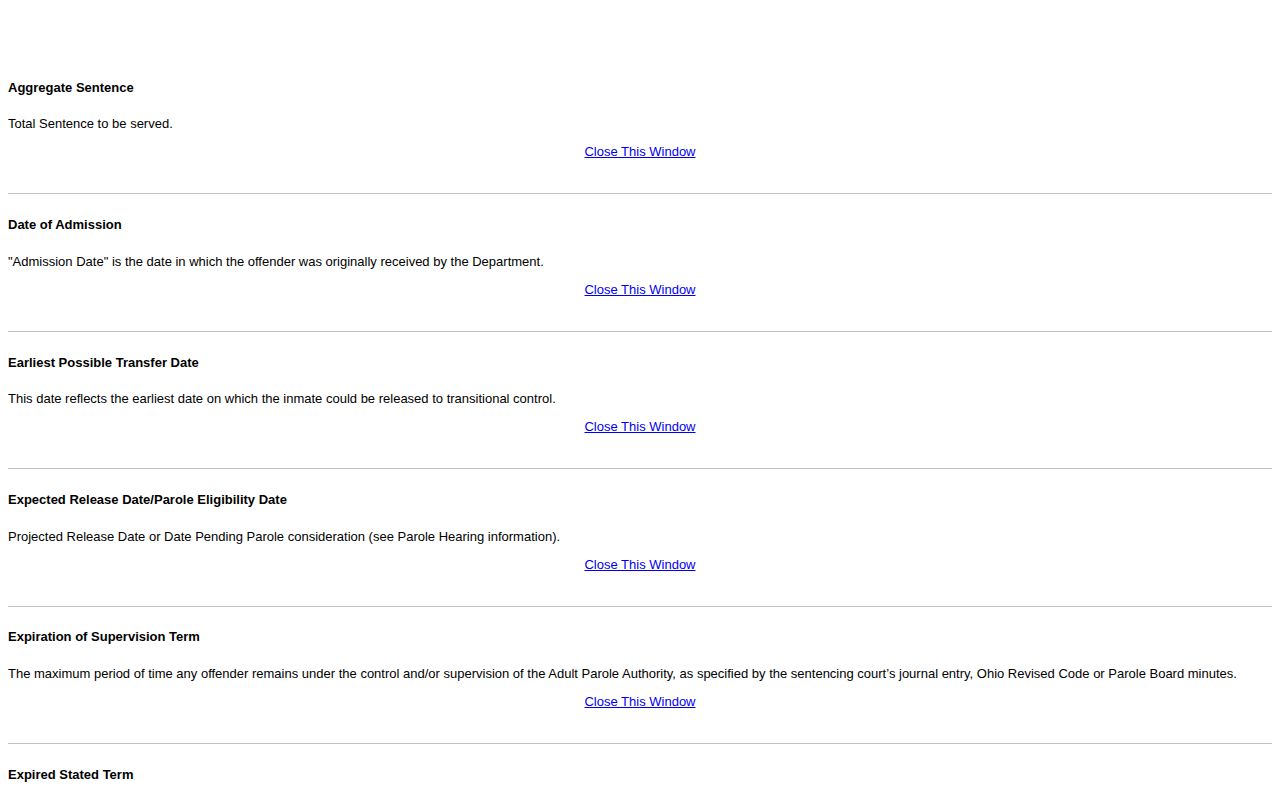
The definitions reinforce that an expected date can also be a parole-eligibility date. It must be read with the person’s sentence model and latest Board information.
| ODRC field | Use |
|---|---|
| Status | Current ODRC category, such as Incarcerated, APA Supervision, or Released. |
| Jail-time credit | Qualifying prior confinement credited to the state term. |
| Expected Release Date/Parole Eligibility Date | Forward-looking projection or eligibility point, depending on the case. |
| Hearing or review fields | Scheduling and latest Board action where parole applies. |
| Supervision Start Date | Retrospective evidence that prison release to APA supervision occurred. |
Ohio Earned Credit Rules
For confinement on or after April 4, 2024, ORC 2967.194 is the principal earned-credit statute. Eligible people may provisionally earn one or five days for each completed month of productive participation in an approved activity, depending on category. Additional completion credit can apply. The aggregate monthly and activity credit is capped at 15 percent of the stated term, while completion provisions have separate limits.
Eligibility is not automatic. Credits can be denied or withdrawn for rule violations. Qualifying participation and good standing matter. The implementing OAC 5120-2-06 generally uses five days per month, one day for specified older sexually oriented offenses, and no credit for covered sexual offenses committed on or after September 30, 2011. Mandatory firearm and other listed mandatory portions are not creditable.
Major exclusions include nonreducible or mandatory terms, death sentences, aggravated murder and murder, specified life structures, and covered sex offenses. Historical ORC 2967.193 may matter for confinement before the transition, but it is not the current rule for every case.
The current Ohio earned-credit law is the source for the eligibility and limit details.
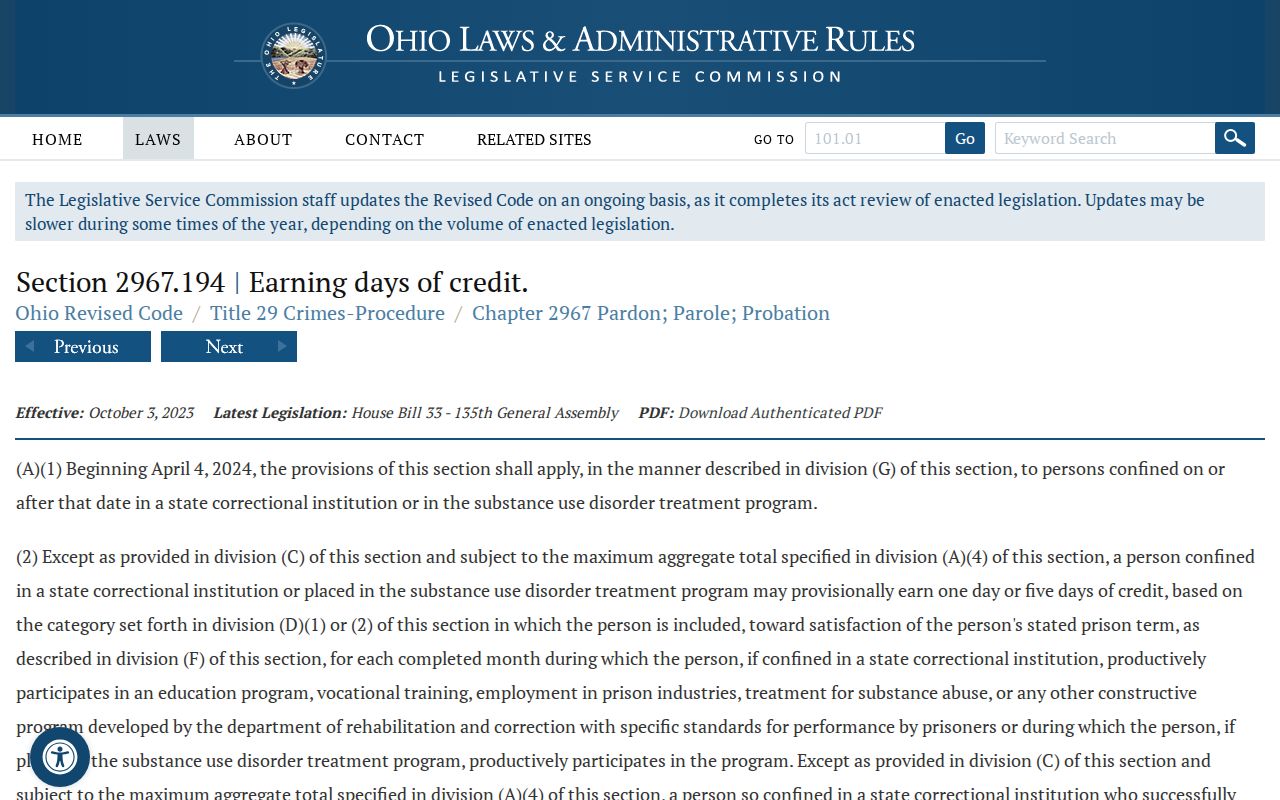
This statute should be applied to the actual sentence and offense, not used as a flat percentage for all Noble County inmates.
Note: Jail-time credit reflects qualifying prior custody; earned credit depends on later program participation and conduct.
Noble County Indefinite Sentence Dates
Many first- and second-degree felonies committed under the Reagan Tokes framework after March 22, 2019 use an indefinite minimum and maximum term under ORC 2929.14. Under ORC 2967.271, release is presumed at the minimum or applicable presumptive earned-early-release date. ODRC can rebut that presumption at a hearing for specified conduct and security findings, continuing confinement up to the maximum.
This framework makes a single date especially easy to misread. The minimum, maximum, any earned-early-release calculation, and later hearing result belong together. Exceptional-conduct reductions may affect the minimum for a qualifying person. A rebuttal can extend confinement. Neither possibility should be assumed from the sentence length alone.
The Ohio indefinite-term release statute shows the presumption and rebuttal process.
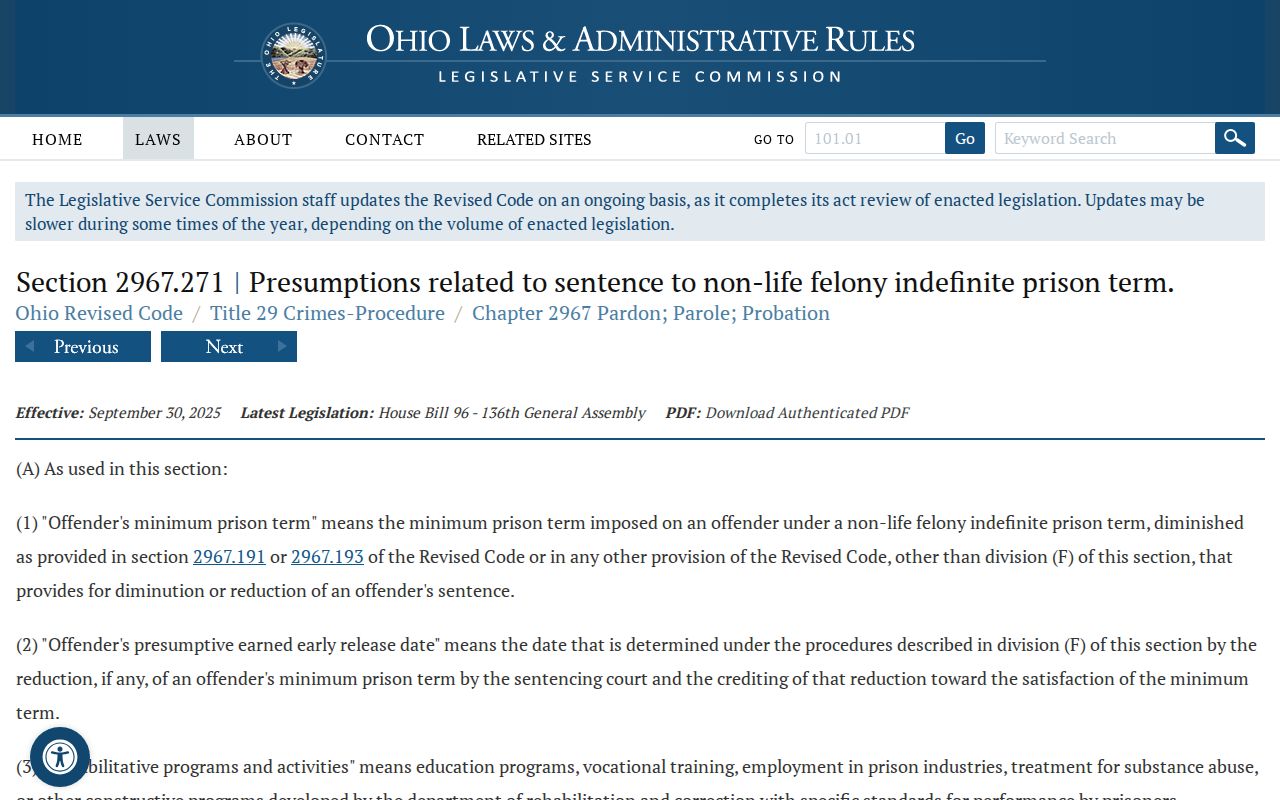
The statutory process explains why a displayed minimum or projected date may not become the actual day of departure.
Why Noble County Release Dates Change
A date can move for reasons found in the sentence, correctional record, or a later legal event. The responsible source differs for each factor. ODRC calculates state terms, courts control their orders, and custodians document actual movement. A detainer is a request or authority for another agency to take custody; it can prevent a planned community release even when one term ends.
| Factor | Possible effect | Best record |
|---|---|---|
| Jail-time credit | Changes the credited start or remaining state term | Sentencing entry and ODRC detail |
| Earned or completion credit | May move an eligible projection earlier | ODRC computation |
| Credit loss or misconduct | May delay the projection or support later action | ODRC institutional record |
| Court correction or judicial release | Can alter the sentence or authorize an earlier exit | Court journal entry |
| Parole Board action | May deny, continue, condition, or set a projected date | ODRC hearing result or Board record |
| Detainer or receiving agency | May turn a planned community release into a transfer | Custody movement record |
| Indefinite-term rebuttal | May continue confinement beyond the presumptive point | ODRC hearing record |
Ohio has no universal rule that every prisoner serves exactly 85 percent. That figure is only arithmetic based on a 15 percent aggregate credit ceiling in a limited fully eligible case. Mandatory time, exclusions, participation, completion credits, court action, and indefinite terms can all make the real result different.
Noble County Jail Date Calculations
ODRC earned-credit statutes govern ODRC confinement. They must not be copied onto a Noble County Jail sentence. The official county sources reviewed do not publish a local good-time formula or a weekend-advance rule. When a local sentence is involved, begin with the sentencing entry and ask the jail how the ordered days and any jail credit were applied.
The Common Pleas record search covers felony matters and warns that online entries can lag judicial action by at least 24 hours or longer. Noble County Court CaseLook covers misdemeanor and traffic matters. A court entry can establish sentence, time served, bond, dismissal, or other authority. It may not show the exact minute jail staff completed release processing.
For the administrative event, contact the Noble County Sheriff at 740-732-5837. A written request can seek the booking identifier, admitted and released date and time, release type, and destination or receiving agency. The sheriff’s form provides no guaranteed turnaround or published local fee schedule, so request a cost estimate when copies are needed.
Confirm Noble County Actual Release
A projection answers what the responsible system currently calculates. It does not answer whether release happened. For ODRC, compare the date with current status, supervision start, institution, and latest hearing result. For the county jail, ask for the sheriff’s release or movement field. A person moved to another jail, ODRC, federal custody, or ICE remains in custody.
VINELink can send a person-specific custody notice, but its agency-fed data can lag. Registration and confirmation steps are covered on the Noble County VINELink release check. After an alert, call the named facility. Ask whether the event was community release or transfer, then obtain the agency record if documentary proof matters.
Use plain, bounded wording in any note. “ODRC displays an expected release or parole-eligibility date” states what the field shows. “The person will leave that day” makes a promise the record does not support. Once the status changes, record the new status and timestamp rather than preserving the old projection as current fact.
If the displayed total appears wrong, compare the sentencing entry with ODRC’s jail-time credit, sentence effective date, and aggregate term. Do not add jail credit and earned credit from memory. The court controls its judgment, while ODRC Central Records controls the state computation. ODRC directs written Central Records correspondence to P.O. Box 430, Columbus, Ohio 43216. A correction in one system may take time to reach a downstream notification service.
- Projected date
- A forward-looking calculation that can change.
- Parole eligibility
- The point when an eligible person may be considered, not a release grant.
- Actual release
- The custodian’s completed departure event.
- Detainer
- Authority or a request for another agency to assume custody.